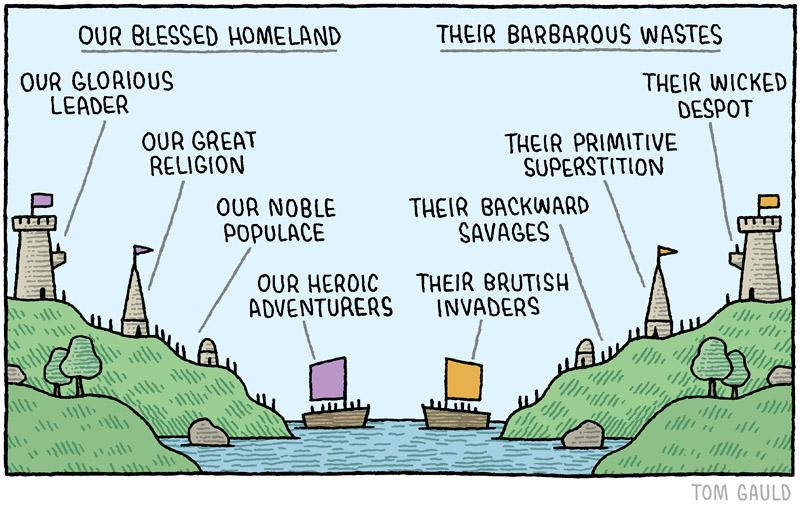
Is it just one is a government

It’s what the government wants to tell its citizens.
Any government can enact terrorist attacks or military strikes. However, random people can only conduct terrorist attacks (as they don’t have a military). The lines get blurred when you are talking about insurgent factions and occupied peoples. But it’s essentially a semantic choice depending on the propaganda you want to promulgate.
Why are half the words missing in your version? Here is the original:
Appears I’d downloaded a genericized meme template.
Can freedom fighters against dictator use the word military strike
They can call it whatever they like, but if there’s only a small handful the best the international community will grant is a “guerrilla” attack.
Their British, what? Their barbarous, what?
:::
there spelling
Nominally:
-
A terrorist attack is primarily intended to kill civilians or cause damage to civilian lives in order to cause fear of the attacking group, anger against the victims’ own government, or otherwise cause a change of policy. The deaths of people with no relationship to any ongoing military operation or force is “a feature, not a bug”. Military targets may also be hit, or the goal may even be to selectively target civilians to emphasize that their military cannot protect them.
-
A military strike is primarily intended to deteriorate an enemy force’s ability to wage warfare: by killing soldiers or leadership, destroying materiel or supplies being used to fight, or destroying industry or logistics being used to support the war effort. Civilian deaths are an unavoidable side-effect of strikes primarily intended to hamper military warfighting capability.
That’s the theoretical line.
In practice, of course, there are many points of disputation - how many degrees separated from a man holding a gun must a target be before it is “non-military”? If an organization which mainly targets civilians in terrorist attacks carries out an attack on a military target, that still might be referred to as a “terrorist attack”, as in, “an attack by a terrorist organization”. And of course, there’s a degree of publicity shaping involved in this as well. But in concept, the above is your line.
“Rapid dominance attempts to affect the will, perception, and understanding of the adversary to fight or respond to our strategic policy ends through imposing a regime of Shock and Awe” (Ullman & Wade, 1996)
One could argue that “shock & awe” is a military strategy to specifically terrorize the enemy force, for example a military opponent. This would blur the line above (terrorism vs military) as it intends to affect the opponents minds with fear of the attacking group and thus coerce them away from their goal.
This strategy is one performed by an organized military that is (theoretically) bound by the rules of warfare (like the Geneva Convention) and unlawful acts can be prosecuted by either their own military law system or an international court (like the Hague). Non-state actors (insurgents, terrorist groups) on the other hand are not beholden to any law. To me, this is another relevant distinction: Is the act itself one of terror or military necessity? And is the actor a governmental organization beholden to the law?
One could argue that “shock & awe” is a military strategy to specifically terrorize the enemy force, for example a military opponent.
Indeed, and that’s why the definition hinges critically on the intended target (civilian vs. military). One could even argue that if you, as a civilian, see your nation’s military forces march out and get torn to ribbons, and then the next night your city’s sky is alive with enemy aircraft bombing military, government, or materiel targets, you have pretty good reason to be scared. But we wouldn’t call this terrorism, even if there are some civilian casualties, because the primary targets are all legitimate ones intended to hamper your ability to wage war.
This strategy is one performed by an organized military that is … bound by the rules of warfare … Non-state actors (insurgents, terrorist groups) on the other hand are not beholden to any law. To me, this is another relevant distinction
This is another good point. We nominally expect that organized nations will adhere to the laws and customs of war. More critically, non-state actors also tend to not have uniforms, stash materiel among civilian populations (often even on sites protected under said laws and customs), and deliberately introduce ambiguity as to whether a target is military or civilian.
But this logic can also get murky when we consider states not recognizing other governments or arguing they are “occupied” by another, more ephemeral hostile force. It can be advantageous for a state to portray their enemy as an ephemeral, non-state actor, in part because it lets you portray the enemy as not adhering to laws and customs of war.
This is the answer I was going to give, there’s such a thing as a legitimate military target, and terrorism is not considered legitimate war. States do terror all the time though, and they have a keen interest in blurring that line.
-
Basically this.


Depends on who is writing the history books
The side you’re on
The only difference between a terrorist group and a military is the size of their budget.
Both are mass murder.
The difference is the State claims the (legal) right to lethal force. It’s still murder. Terrorists (or freedom fighters, depending on outlook) that kill people are murderers. They probably also claim the right to lethal force, which is still murder.
Murder is specifically extra-legal, and as states define their own laws so long as their militaries abide by the laws of their host country and international regulations for warfare it isn’t murder.
They are both killing, however.
There’s an old saying that the difference between a freedom fighter and a guerilla is corporate sponsorships. Seems like a relevant distinction here as well.
The difference is intentions. The intentions of a terrorist attack is to cause terror in the civilian population.
As do many military attacks (like the bombings of London, Dresden, Mainz, Kyiv, etc.)
The blitz (WW2 London) was a terror attack by Hitler’s own admission I think. The explicit aim was to impact civilian morale.
I believe Dresden was justified at the time as being against an industrial base, but the regardless of whether that’s true or not, it was certainly a war crime by today’s standards. Same for the dam attacks.
One group wears a special costume to do its massacres in.
I wanna say the intent behind it but im pretty sure there’s no difference
Terrorist is a social distinction not a rational one; It’s a slur. Trying to launder it with definitions and fixed meaning misses the point.
Terrorist isn’t even synonymous with violence because depending on where you are, a terrorist is a race, ethnicity, politics, or religion.
Generally, terrorist attacks are more about creating terror or (attempting) demoralizing the public, rather than targets that would impact an ongoing war effort or similar. That said, that and “military strike” are not mutually exclusive and seeing as intentions are hard to prove, it tends to be more about branding than anything else.
Terrorism is when politically illegitimate groups use violence to coerce people into complying with your demands out of fear. The terror is key to terrorism. Usually, when a government strikes, it’s not intending to attack civilians, and if it does, it’s not to scare the civilians. It’s to stoke resistance. You could fairly call the Trump regime’s murdering of random boats in the Caribbean terrorism.
Your argument is morally and intellectually weak.
What is the difference between murdering civilians to “stoke resistance” and murdering civilians to “coerce civilians into complying with your demands out of fear”? In both cases you are using violence to influence behavior and the difference is you are childishly imagining “fear” isn’t an emotion when bombs are dropping out of the sky randomly killing people.
How I know your thinking is soft-headed: you mention Trump’s bombing of Venezuelan boats, but not Iranian cities.
It’s not an argument. It’s a textbook definition. I’m sorry you disagree with the standard definition. There’s a time and a place to argue political theory. I hope you have at it with people engaged in that discussion.
We are literally talking about the difference between bombing someone from a plane and bombing them from your chest. This is exactly the place to talk about it.
The dictionary definition is just a start. The question for the adults in the room is how that applies in reality and if there is a real difference between terrorism and, say, an air bombing campaign.
By leaving the definition out there and ending the conversation, you are implicitly arguing that there is a substantive difference.
The question for you is why are shy about engaging in a discussion.
Because this question is clearly asked by someone who appears to be a teenager, or maybe a university student, who doesn’t understand the first thing about international politics. My goal was to answer their question efficiently and in language they understand.
you are implicitly arguing that there is a substantive difference.
No, I’m not arguing that. That’s taken as a fact central to the definition of terrorism. Whether you personally agree with it or not, that is how the word is used. When government actors use the word “terrorism,” they’re not referring to recognized government military action. If you argue otherwise, you’re teaching this person to misunderstand the language their government uses.
Now you can make an entirely separate argument that goes along the lines, “The definition may be that, but I think it SHOULD be something else!” That’s what your response is doing. That’s an argument I have no stake in personally and did not bring upon by myself by just explaining the definition.
“Government says that when it does terrorism, it’s called something else, so it’s not terrorism.”
I read this question as someone asking what is the SUBSTANTIVE difference between the two, because maybe they are struggling to see a difference between a president who LITERALLY THREATENS NUCLEAR ANNIHILATION UNLESS HIS POLITICAL DEMANDS ARE MET after bombing school children and a “terrrorist.”
“Terrorism” is one of the biggest emotional trigger words in the political language. If you want to discredit your enemy and remove their legal rights, you can call them a terrorist. If you want to terrorize people as a state actor, you have ample semantic and legal tools to pretend you are not committing terrorism, inlcuding text book definitions.
Having an indifference to that is deeply unserious. You are doing nobody any favors.